
Updated:
What meeting minutes are for
Minutes are the official record of a meeting: who was there, what was decided and who will do what by when. They're not a transcript. Someone who missed the meeting should be able to read them in two minutes and know what changed.
What to include
- Basic details: meeting name, date and time, location or link, chair and minute-taker.
- Attendees and people who were absent.
- The agenda items, in order.
- For each item, a short summary of the discussion: the main arguments, not every sentence.
- Decisions, written as clear statements (“We will launch on iOS only on 1 December.”).
- Action items, each with an owner and a due date.
- Open questions that were carried over, and the date of the next meeting.
A simple process
Before the meeting
- Get the agenda and set up the minutes document with the agenda items already in place.
- Agree who takes the minutes. The person chairing the meeting shouldn't do both.
During the meeting
- Write down decisions and action items the moment they happen. Everything else can be filled in later.
- When a decision is vague, ask: “So we're deciding that… who owns it, and by when?” It's the minute-taker's most useful question.
- Note exact numbers, dates and names. These are what people argue about later.
After the meeting
- Clean up the notes within a few hours, while you still remember the context.
- Keep it short: a paragraph per agenda item is usually enough.
- Send the minutes to attendees the same day and ask for corrections within a set time.
- Start the next meeting by reviewing the open action items from these minutes.
Free meeting minutes template
Meeting minutes template (Word)
Basic details, agenda, discussion, decisions, an action items table and next steps. Free to use and edit.
Template (copy and paste)
MEETING MINUTES

Meeting:
Date and time:
Location / link:
Chair:
Minutes taken by:
Attendees:
Absent:

1. Agenda
1.
2.
3.

2. Discussion
Item 1: Short summary, main points raised
Item 2:
Item 3:

3. Decisions
D1:
D2:
D3:

4. Action items
Action | Owner | Due date
… | … | …
… | … | …

5. Open items / carried over
-

6. Next meeting
Date and time:
Proposed agenda:

Minutes sent to attendees within 24 hours of the meeting. Corrections to: ……
Common mistakes
- Writing a transcript instead of minutes. Nobody reads ten pages.
- Decisions without owners or dates. “We'll look into it” is not an action item.
- Waiting a week to send them. By then, people remember the meeting differently.
- Recording opinions as decisions. If something was discussed but not agreed, put it under open items.
Formal minutes
Board meetings, general assemblies and some public bodies have legal rules for minutes, such as required content, signatures and archiving. This guide covers everyday team meetings; for formal minutes, follow your organization's rules.
Letting software draft them
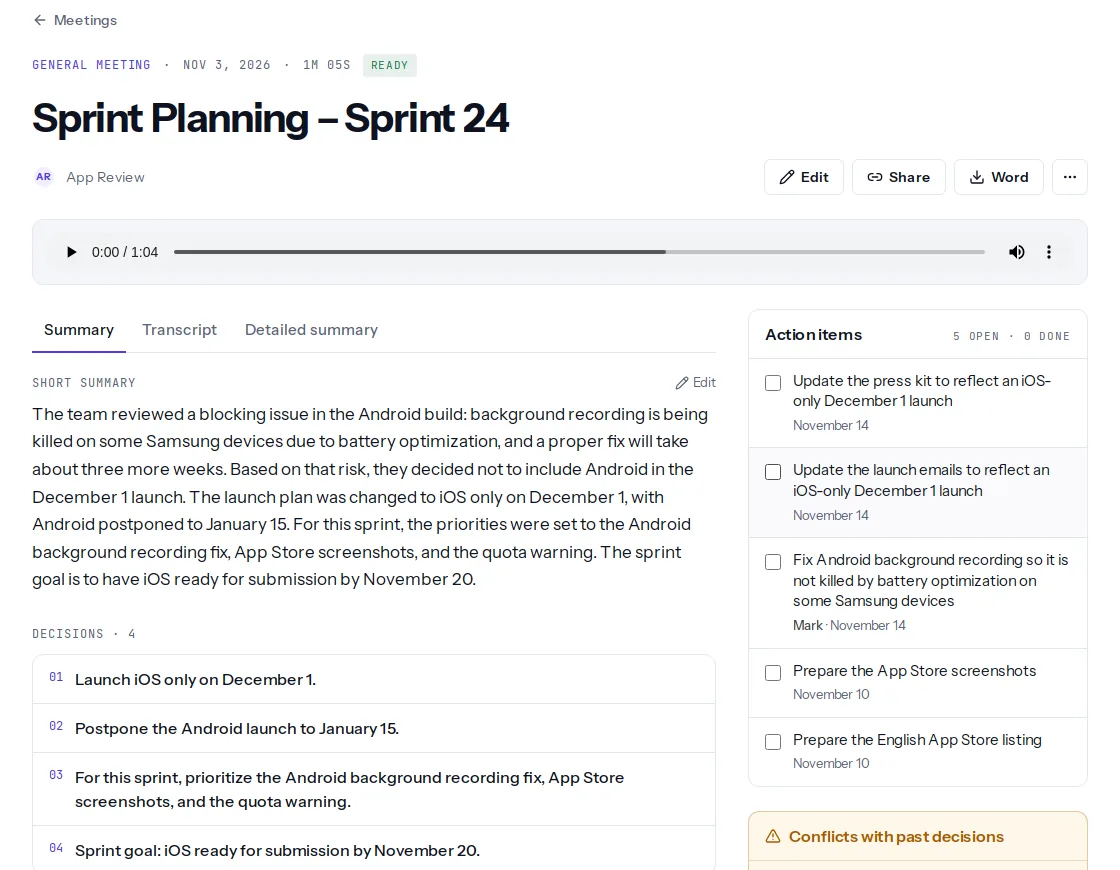
If you record the meeting, a tool like Notal can draft most of this for you: a short summary, the list of decisions and action items with owners and dates. You still review it, fix anything that came out wrong and send it, but you start from a complete draft instead of a blank page.
Frequently asked questions
How long should meeting minutes be?
As short as possible while still clear to someone who wasn't there. For a one-hour team meeting, one page is usually enough.
Should minutes be written in the past tense?
Yes, for the discussion (“The team reviewed…”). Decisions and action items can be written as clear statements of what will happen.
Do I need to record who said what?
For everyday meetings, usually not; record decisions and the main arguments. For formal meetings, follow your organization's rules.
Can I record the meeting to write minutes?
Yes, as long as participants know and, where required, agree. A recording makes the minutes more accurate, especially for numbers and dates.